
Better sleep shouldn’t be so hard
We use cutting-edge sleep science to help you feel calmer, sleep deeply, wake up more rested, and actually look forward to bedtime again.
Poor sleep is learned, which means it can be unlearned
It’s a self-perpetuating cycle, which is why short-term fixes don’t hold.
And back to 01 — that’s the cycle.
CBT-I is how you unlearn it
CBT-I is a clinically proven cognitive therapy that addresses the root cause of poor sleep and its cycle.
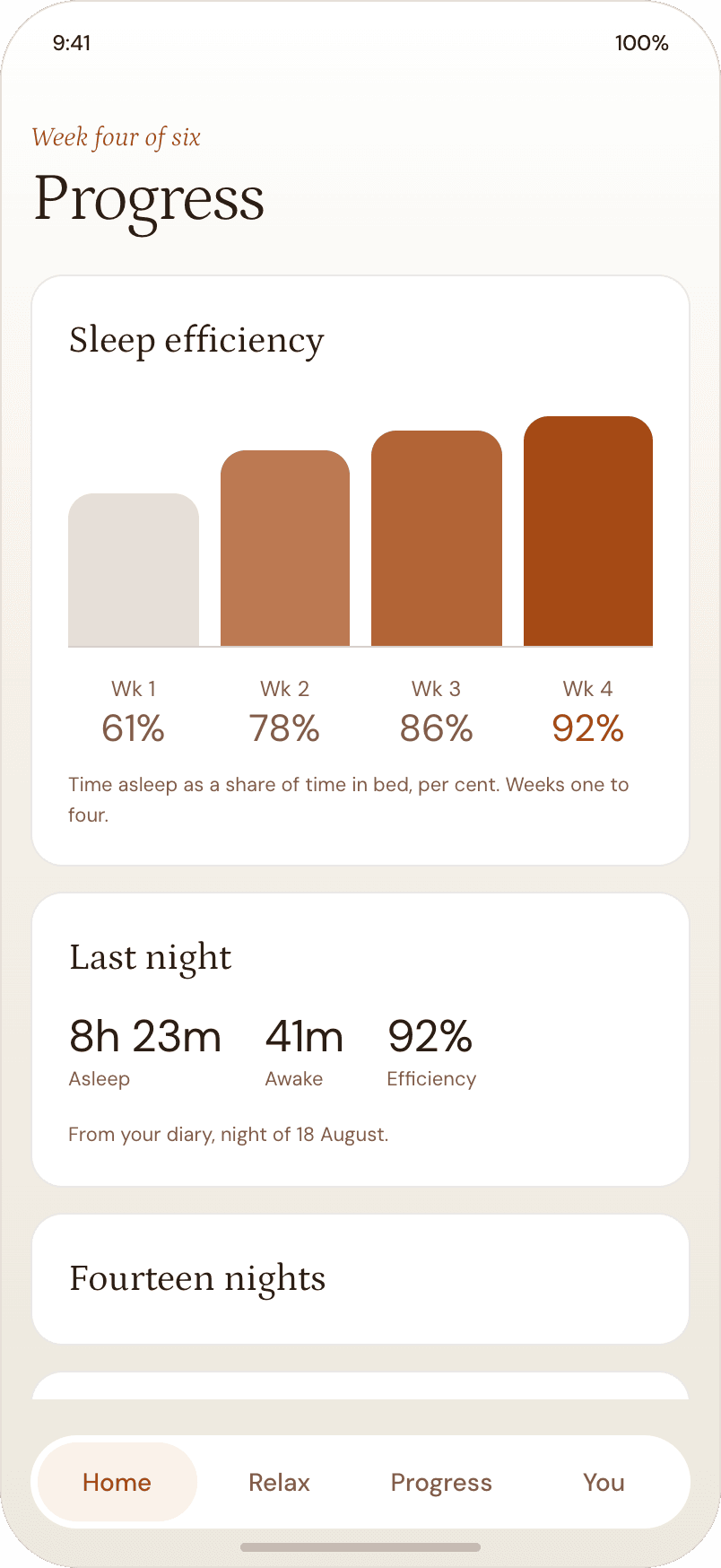
Results of CBT-I, which Solace is built on.
See how we’ve helped others
“I honestly didn’t think it would work. I’d been awake at 3am most nights for about two years and I’d decided that was just me now. About two weeks in I realized I’d stopped bracing for it in the evening. Nothing dramatic happened. It was mostly what I stopped doing.”
HelenPhotographs are illustrative. Members’ own images are not shown, to protect their privacy.
What changes, and when
How Solace works with you
- Sleep restrictionYour time in bed is set from your last seven nights, then widened as your sleep holds.
- Stimulus controlBed goes back to being the place you sleep, not the place you lie awake.
- Cognitive restructuringThe thoughts that arrive at 3am get examined against what actually happens the next day.
- Relaxation trainingPracticed techniques that lower the arousal keeping your body on alert.
- Relapse preventionA written plan for the next bad week, finished before you need it.
All your other questions
What actually happens over the six weeks?
Five techniques in clinical order: a sleep window set from your own diary, stimulus control, cognitive work on the thoughts that keep you awake, relaxation training, then a relapse plan. Each one arrives once the one before it has had time to work.
How long until I see an improvement?
Most people notice something in the first two weeks — falling asleep faster, or less time awake in the night. The fuller change takes the six weeks, and the gains generally hold once the program ends.
Who is this for?
Adults whose sleep has been broken for three months or more, and who spend enough time in bed without enough of it asleep. It is the wrong starting point for untreated sleep apnea, a circadian disorder or night shifts — the assessment checks for those and tells you before you pay.
Is this therapy?
It is the CBT-I protocol a sleep clinic would use, delivered as a six-week program rather than in appointments. It is not a substitute for advice from your own doctor.
Do I need a wearable?
No. It runs on a sleep diary you fill in each morning — about twenty seconds, and what every CBT-I trial was built on. A tracker also invites watching a score all night, which is the opposite of what the method is asking of you.
I take sleep medication. Can I still do this?
Yes, and nothing here asks you to change what you take. CBT-I is often what people use to come off medication later, but any change to a prescription is a conversation with whoever wrote it.
What happens after week six?
You keep the method. You leave with your own window, the rules that got you to it, and a written plan for the next bad week — which is the part that stops this being another thing that worked for a while.